| What is System Software? – Definition, Types, Examples and More | 您所在的位置:网站首页 › meaning system › What is System Software? – Definition, Types, Examples and More |
meaning system What is System Software? – Definition, Types, Examples and More
|
System software refers to the low-level software that manages and controls a computer’s hardware and provides basic services to higher-level software. There are two main types of software: systems software and application software. Systems software includes the programs that are dedicated to managing the computer itself, such as the operating system, file management utilities, and disk operating system (or DOS). What is System Software?System software is software that provides a platform for other software. Some examples can be operating systems, antivirus software, disk formatting software, computer language translators, etc. These are commonly prepared by computer manufacturers. This software consists of programs written in low-level languages, used to interact with the hardware at a very basic level. System software serves as the interface between the hardware and the end users. System software refers to the collection of programs and software components that enable a computer or computing device to function properly. It acts as an intermediary between the user and the computer hardware, allowing the user to interact with the hardware and use various applications and programs. Some common types of system software include operating systems (such as Windows, macOS, or Linux), device drivers, utility programs, programming languages, and system libraries. Operating systems are the most important type of system software, as they provide the foundational framework for all other software and applications to run on the computer. They manage computer resources, such as memory and processing power, and provide a user interface for users to interact with the system. Device drivers are another important type of system software, as they allow the operating system to communicate with hardware devices such as printers, scanners, and graphics cards. Utility programs provide additional functionality to the operating system, such as disk defragmentation, virus scanning, and file compression. Examples of System SoftwareSystem software is a type of computer program that is designed to run a computer’s hardware and application programs and examples of system software include operating systems (OS) (like macOS, Linux, Android, and Microsoft Windows), game engines, search engines(like google,Bing,Yahoo!), industrial automation, computational science software, and (SaS)software as a service applications. Operating systems (OS): Windows, Linux, macOS, etc. Device drivers: software that enables the communication between hardware and OS. Firmware: pre-installed low-level software that controls a device’s basic functions. Utility software: tools for system maintenance and optimization. Boot loaders: software that initializes the OS during startup. Why use System Software?Here are some reasons why system software is necessary: Hardware Communication: System software serves as an interface between the hardware and software components of a computer, enabling them to communicate and work together. Resource Management: System software manages computer resources such as memory, CPU usage, and storage, optimizing their utilization and ensuring that the system operates efficiently. Security: System software provides security measures such as firewalls, antivirus software, and encryption, protecting the system and its data from malware, viruses, and other security threats. User Interface: System software provides a user interface that allows users to interact with the computer or computing device and perform various tasks. Application Support: System software supports the installation and running of applications and software on the system. Customization: System software allows for customization of the system settings and configuration, giving users greater control over their computing environment. Features of System SoftwareThe most important features of system software are as below. Memory Management: operating system perform memory management. The OS keeps track of the primary memory and allocates the memory when a process requests it. Processor Management: OS performs process management. Allocates the main memory (RAM) to a process and de-allocates it when it is no longer required. File Management: Operating system perform file management. Allocates and de-allocates the resources and decides who gets the resources. Security: Prevents unauthorized access to programs and data using passwords. Error-detecting Aids: Production of dumps, traces, error messages, and other debugging and error-detecting methods. Scheduling: The OS schedules the process through its scheduling algorithms. Types of System Software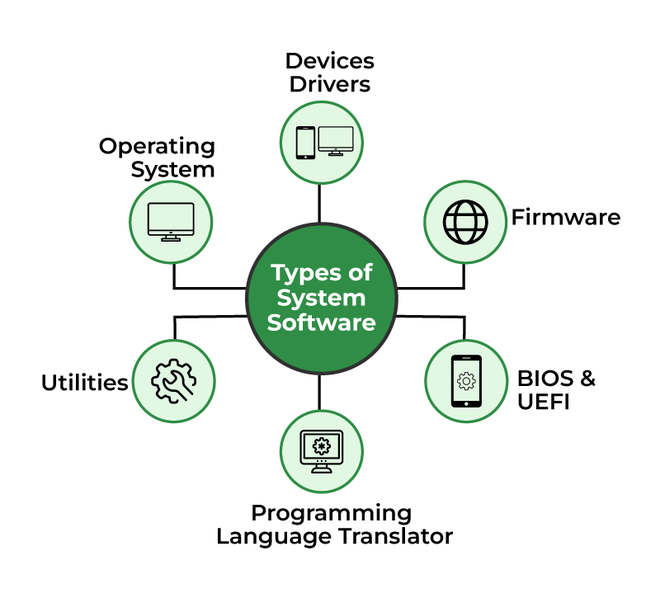 Types of System Software 1. Operating SystemAn operating system (OS) is a type of system software that manages a computer’s hardware and software resources. It provides common services for computer programs. An OS acts as a link between the software and the hardware. It controls and keeps a record of the execution of all other programs that are present in the computer, including application programs and other system software. Important Tasks Performed by the Operating SystemThe main functions of operating systems are as follow: Resource Management: The operating system manages and allocates memory, CPU time, and other hardware resources among the various programs and processes running on the computer. Process Management: The operating system is responsible for starting, stopping, and managing processes and programs. It also controls the scheduling of processes and allocates resources to them. Memory Management: The operating system manages the computer’s primary memory and provides mechanisms for optimizing memory usage. Security: The operating system provides a secure environment for the user, applications, and data by implementing security policies and mechanisms such as access controls and encryption. File Management: The operating system is responsible for organizing and managing the file system, including the creation, deletion, and manipulation of files and directories. Device Management: The operating system manages input/output devices such as printers, keyboards, mice, and displays. It provides the necessary drivers and interfaces to enable communication between the devices and the computer.For more, refer to Functions of Operating System. 2. Programming Language TranslatorProgramming language translators are programs that translate code written in one programming language into another programming language. below are examples of programming language translator. Compiler: A compiler is a software that translates the code written in one language to some other language without changing the meaning of the program. The compiler is also said to make the target code efficient and optimized in terms of time and space. A compiler performs almost all of the following operations during compilation pre-processing, lexical analysis, parsing, semantic analysis (syntax-directed translation), conversion of input programs to an intermediate representation, code optimization, and code generation. Examples of compilers may include gcc(C compiler), g++ (C++ Compiler ), javac (Java Compiler), etc. Interpreter: An interpreter is a computer program that directly executes, i.e. it performs instructions written in a programming or scripting language. Interpreters do not require the program to be previously compiled into a machine language program. An interpreter translates high-level instructions into an intermediate form, which is then executed. Interpreters are fast as it does not need to go through the compilation stage during which machine instructions are generated. The interpreter continuously translates the program until the first error is met. If an error comes it stops executing. Hence debugging is easy. Examples may include Ruby, Python, PHP, etc. Assembler: An assembler is a program that converts the assembly language into machine code. It takes the basic commands and operations and converts them into binary code specific to a type of processor. Assemblers produce executable code that is similar to compilers. However, assemblers are more simplistic since they only convert low-level code (assembly language) to machine code. Since each assembly language is designed for a specific processor, assembling a program is performed using a simple one-to-one mapping from assembly code to machine code. On the other hand, compilers must convert generic high-level source code into machine code for a specific processor. 3. Device DriversDevice drivers are a class of system software that minimizes the need for system troubleshooting. Internally, the operating system communicates with hardware elements. Device drivers make it simple to manage and regulate this communication. To operate the hardware components, the operating system comes with a variety of device drivers. The majority of device drivers, including those for a mouse, keyboard, etc., are pre-installed in the computer system by the businesses that make computers. 4. FirmwareThese are the operational programs installed on computer motherboards that assist the operating system in distinguishing between Flash, ROM, EPROM, and memory chips. However, managing and controlling all of a device’s actions is the main purpose of any firmware software. For initial installation, it makes use of non-volatile chips. There are mainly two main types of firmware chips: BIOS (Basic Input/Output System) chip. UEFI (Unified Extended Firmware Interface) chips. 5. Utility SoftwareSystem Software and application software interact through utility software. A third-party product called utility software is created to lessen maintenance problems and find computer system defects. It is included with your computer’s operating system. Listed below are some particular attributes of utility software: Users benefit from protection from threats and infections. WinRAR and WinZip are programs that aid in reducing disk size. It assists with disk partitioning and functions as a windows disk management service. It makes it easier for users to back up old data and improves system security. It operates as a disk defragmenter to organize the dispersed files on the drive. It aids in the recovery of lost data. Uses of System SoftwareHere are some common uses of system software: Operating systems: An operating system is a type of system software that manages computer hardware and software resources and provides common services for computer programs. Operating systems are used in a wide variety of applications, from personal computers to servers, supercomputers, and embedded systems. Device drivers: Device drivers are a type of system software that allow operating systems to communicate with hardware devices such as printers, scanners, and graphics cards. Without device drivers, operating systems would not be able to interact with hardware devices, making them useless. Firmware: Firmware is a type of system software that provides low-level control over hardware devices such as BIOS firmware, firmware for embedded systems, and firmware for network devices such as routers and switches. System utilities: System utilities are a type of system software that performs routine maintenance tasks such as disk cleanup, defragmentation, antivirus scanning, and system backups. These utilities help ensure that the computer system is running efficiently and securely. Programming tools: Programming tools are a type of system software that is used by developers to create, debug, and optimize software applications. These tools include compilers, debuggers, integrated development environments (IDEs), and performance analysis tools. Issues in System Software Compatibility Issues: System software may not be compatible with certain hardware components, which can cause errors or crashes. Security Issues: System software may contain vulnerabilities that can be exploited by hackers or malware to gain unauthorized access to the system or steal sensitive data. Performance Issues: System software may not be optimized for the hardware or may be resource-intensive, which can cause the system to slow down or freeze. Update Issues: System software updates may contain bugs or compatibility issues that can cause problems with the system or other software components. Licensing Issues: Some system software may require licensing or activation, which can cause problems if the license expires or if there are licensing errors. User Interface Issues: The user interface of system software may not be intuitive or may be difficult to use, which can affect the user experience. Advantages of System Software Resource management: System software manages and allocates resources such as memory, CPU, and input/output devices to different programs. Improved performance: System software optimizes the performance of the computer and reduces the workload on the user. Security: System software provides security features such as firewalls, anti-virus protection, and access controls to protect the computer from malicious attacks. Compatibility: System software ensures compatibility between different hardware and software components, making it easier for users to work with a wide range of devices and software. Ease of use: System software provides a user-friendly interface and graphical environment, making it easier for users to interact with and control the computer. Reliability: System software helps ensure the stability and reliability of the computer, reducing the risk of crashes and malfunctions. Increased functionality: System software provides a range of tools and utilities for performing various tasks, increasing the functionality and versatility of the computer. Disadvantages of System Software Complexity: System software can be complex and difficult to understand, especially for non-technical users. Cost: Some system software, such as operating systems and security software, can be expensive. System Overhead: The use of system software can result in increased system overhead, which can slow down the performance of the computer and reduce its efficiency. Vulnerability: System software, especially the operating system, can be vulnerable to security threats and viruses, which can compromise the security and stability of the computer. Upgrades: Upgrading to a newer version of system software can be time-consuming and may cause compatibility issues with existing software and hardware. Limited Customizability: Some system software may have limited options for customization, making it difficult for users to personalize their computing experience. Dependency: Other software programs and devices may depend on the system software, making it difficult to replace or upgrade without disrupting other systems. Difference between System Software and Application SoftwareHere are the main difference points between software and application software System Software Application Software System Software maintains the system resources and gives the path for application software to run. Application software is built for specific tasks. Low-level languages are used to write the system software. While high-level languages are used to write the application software. It is general-purpose software. While it’s a specific purpose software. Without system software, the system stops and can’t run. While Without application software system always runs. System software runs when the system is turned on and stops when the system is turned off. While application software runs as per the user’s request. Example: System software is an operating system, etc. Example: Application software is Photoshop, VLC player, etc. System Software – FAQs 1. How operating systems communicate with hardware devices?operating systems communicate with hardware devices with the help of device drivers. Device driver is a type of system software. 2. What is the use of system software in resource management?System software manages computer resources such as memory, CPU usage, and storage, optimizing their utilization and ensuring that the system operates efficiently. 3. What are examples of system software?System software includes multiple applications, like utilities, operating systems, compilers and debuggers, that lie at a level of functionality like the computer hardware. Next Article Utility SoftwareA Ayusharma0698 Improve
Article Tags :
School Programming
CBSE - Class 11
school-programming
Similar Reads
Computer Fundamental Tutorial
This Computer Fundamental Tutorial covers everything from basic to advanced concepts, including computer hardware, software, operating systems, peripherals, etc. Whether you're a beginner or an experienced professional, this tutorial is designed to enhance your computer skills and take them to the n
7 min read
Introduction To Computer Fundamentals
What is Computer?
A computer is an electronic device that can process and store information. It can perform calculations, manipulate data, and execute instructions to accomplish specific tasks. The basic components of a computer include the central processing unit (CPU), memory (RAM), storage (hard drive or solid-sta
15+ min read
Basics of Computer and its Operations
Introduction : A computer is an electronic device that can receive, store, process, and output data. It is a machine that can perform a variety of tasks and operations, ranging from simple calculations to complex simulations and artificial intelligence. Computers consist of hardware components such
12 min read
Advantages and Disadvantages of Computer
The computer is a programmed device with a group of instructions to perform specific tasks and generate results at a really high speed. A Computer is a machine that can solve difficult and different problems, process data, store & retrieve data, and perform calculations faster and more accuratel
5 min read
Classification of Computers
The computer systems can be classified on the following basis: 1. On the basis of size. 2. On the basis of functionality. 3. On the basis of data handling. Classification on the basis of size Super computers : The super computers are the most high performing system. A supercomputer is a computer wit
5 min read
Basic Applications of Computers
The term computer was taken from the Greek word compute means calculation and the computer was a person or device that did computation. In this article, we will learn what exactly a computer is, how it affects our lives, and the applications of computers in our life. What is a Computer?A computer is
6 min read
History and Evolution of Computers
History of Computers
Before computers were developed people used sticks, stones, and bones as counting tools. As technology advanced and the human mind improved with time more computing devices were developed like Abacus, Napier's Bones, etc. These devices were used as computers for performing mathematical computations
7 min read
Generations of Computer
Introduction: A computer is an electronic device that manipulates information or data. It can store, retrieve, and process data. Nowadays, a computer can be used to type documents, send an email, play games, and browse the Web. It can also be used to edit or create spreadsheets, presentations, and e
5 min read
Components of a Computer System
Central Processing Unit (CPU)
CPU [Central Processing Unit]. It is the brain of the computer. It is the part that does most of the work in a computer system. Just like how our brain controls our body and processes information, the CPU carries out instructions from programs and performs calculations. It's made up of smaller compo
10 min read
What are Input Devices?
Input devices are the parts of the computer that we interact with daily and are used to input data to the computers. An input device is a hardware device that transfers data to a computer system and allows us to control it. What is an Input Device?The electromagnetic devices that accept data or a se
10 min read
What are Different Output Devices?
Output Devices are those devices which show us the result after giving the input data to a computer system. Output can be in different forms like image, graphic audio, video, etc. What is an Output Device?Any peripheral that accepts data from a computer and prints, projects, or reproduces it is know
10 min read
Computer Hardware
Computer hardware includes the physical parts of a computer, such as a case, central processing unit (CPU), random access memory (RAM), monitor, and mouse which processes the input according to the set of instructions provided to it by the user and gives the desired output. The computer has mainly h
11 min read
What is a Computer Software?
Computer Software serves as the backbone of all digital devices and systems. It is an integral part of modern technology. Unlike hardware which comprises physical components, software is intangible and exists as a code written in programming language. This article focuses on discussing computer soft
9 min read
Computer Hardware
What is a Motherboard?
The motherboard serves as a single platform to connect all of the parts of a computer together. It can be considered as the backbone of the computer. What is a Motherboard?A computer is an electronic device that processes the data with respect to the user's requirements using IO devices. The data pr
9 min read
Random Access Memory (RAM)
Random Access Memory (RAM) is a type of computer memory that stores data temporarily while a computer is running. It's called "random access" because the computer can access any part of the memory directly and quickly. RAM (Random Access Memory) is very similar to memory in the Human Brain. The huma
13 min read
Hard Disk Drive (HDD) Secondary memory
Primary memory has limited storage capacity and it is volatile. Secondary memory overcomes this limitation by providing permanent storage of data in bulk quantity. Secondary memory is also termed external memory and refers to the various storage media on which a computer can store data and programs.
12 min read
Introduction to Solid-State Drive (SSD)
SSD is a non-volatile storage device, which stands for Solid State Drive, and protocols such as SATA and SAS of traditional hard disk drives (HDD) may be used. New form factors such as the M.2 form factor, and new I/O protocols such as NVM Express have been developed to address specific requirements
7 min read
What is a Graphics Processing Unit (GPU)?
Graphics Processing Unit (GPU) is a specialized processor originally designed to render images and graphics efficiently for computer displays. In recent years, GPUs have evolved into powerful co-processors that excel at performing parallel computations, making them indispensable for tasks beyond gra
6 min read
What is Power Supply Unit (PSU)?
A PSU is a type of internal hardware used in information technology systems. Power Supply Units (PSUs), despite their name, transform power rather than providing it to systems. In particular, a power supply regulates the DC output voltage to the precise tolerances needed for contemporary computing c
14 min read
Computer Software
What is a Computer Software?
Computer Software serves as the backbone of all digital devices and systems. It is an integral part of modern technology. Unlike hardware which comprises physical components, software is intangible and exists as a code written in programming language. This article focuses on discussing computer soft
9 min read
Software and its Types
Software is a collection of instructions, data, or computer programs that are used to run machines and carry out particular activities. It is the antithesis of hardware, which refers to a computer's external components. A device's running programs, scripts, and applications are collectively referred
7 min read
What is Application Software?
A computer is a piece of electronic equipment. Because it is powered by electricity, it is referred to as an electronic device. It accepts data, processes it, and outputs the appropriate results. The output of a computer system is also known as the result of the computer system. The computer system
10 min read
System Software
System software refers to the low-level software that manages and controls a computer's hardware and provides basic services to higher-level software. There are two main types of software: systems software and application software. Systems software includes the programs that are dedicated to managin
12 min read
Utility Software
Utility software is a type of software that is designed to help users manage, maintain, and optimize their computer systems. Utility software includes a wide range of tools and applications that perform specific tasks to improve the performance, security, and functionality of a computer system. Tabl
8 min read
Input Devices
What is a Keyboard?
Computers have two types of devices â Input and Output devices. Input devices are those devices which take commands from user and convey it to the computers in the form of digital signals. Whereas, output devices are those which display or present the result to the user according to the commands giv
7 min read
What is a Mouse in Computer?
The mouse is the most used pointing device. While clicking and dragging, the mouse moves a little cursor across the screen. If you let off of the mouse, the cursor will come to a halt. You must move the mouse for the computer to move. it will not move on its own. What is a Mouse in a Computer?A mous
6 min read
What is a Joystick?
A joystick is a pointing and controlling device that is commonly used for controlling video games and moving required objects on the system screen. An input device which is called a joystick is used to control a machine or character in a computer program, like an aircraft in a flight simulator syste
8 min read
What is a Light Pen?
A light pen is a type of pointing input device that detects light and is frequently used to select or alter text or data on a screen. These devices, when used with a CRT (cathode ray tube) monitor, were an early method of highlighting and modifying data on the screen. What is a Light Pen?A light pen
6 min read
What is Scanner?
A scanner is an electrical device can read and translate text, images, and other materials into a digital signal. This transforms the documents into a format that computer software programs can use to view and/or edit them. There are many different types of scanners with various resolutions on the m
7 min read
What is Optical Character Recognition (OCR)?
By digitizing the document's content, text-encased image files are produced. Word processing software cannot process text in photos the same way it does text documents. By transforming text photos into text data that can be evaluated by other business tools, OCR technology finds a solution to the is
5 min read
What is a Barcode Reader?
When you visit a supermarket, you might see the cashier scanning a code on the product at the billing counter. Within fractions of minutes, they calculate the total price and create the bill. The cashier can do the billing process faster with the help of a scanner. The scanner that is used to scan t
5 min read
What is WebCam?
A webcam is a video camera that is connected to a computer or other device, typically via a USB port, and is used to capture and transmit video over the internet. Webcams are commonly used for videoconferencing, live streaming, and other applications that require real-time video communication. Webca
10 min read
Output Devices
What is a Speaker?
Computer Speakers or Multimedia speakers we all heard of it, knew it, and even used it in our day-to-day life. They are found everywhere from home appliances to industries, high-corporation factories, and organizations but especially in movie theatres, concerts, and public sessions. It is one of the
7 min read
What is a Printer?
A computer is an electronic device that takes input from the user, processes it, and gives the output. A computer processes the data at a very high speed and with high accuracy. It processes the input according to the set of instructions provided to it by the user and gives the desired output quickl
6 min read
What is a Monitor?
During ancient times, before the introduction of monitors, devices like Abacus and mechanical calculators were used. After the development of the Analytical Engine by Charles Babbage, the theory of computers came into existence. Now the latest computers comprise basic components like Output Devices,
5 min read
What is a Plotter?
Plotter uses multicolored automatic pens to create lines on paper and reads computer orders. It can create charts, maps, graphs, drawings, and more. It uses one or more automated pens to draw a line. What is a Plotter?A plotter is basically a type of printer technology. It is a computer output devic
8 min read
What is a Projector?
Any peripheral that accepts data from a computer and prints, projects, or reproduces it is known as an output device. The output may be audio, video, hard copy â printed paper, etc. Output devices convert the computer data to human understandable form. The projector is also an output device. Let's d
9 min read
What are Headphones?
Headphones are a type of hardware output device that can be connected to a computer's line-out or speakers port, as well as wirelessly using Bluetooth. They are also referred to as earbuds. You can watch a movie or listen to audio without bothering anyone nearby by using headphones. What are Headpho
7 min read
Data Storage and Memory
What is a Storage Device? Definition, Types, Examples
The storage unit is a part of the computer system which is employed to store the information and instructions to be processed. A storage device is an integral part of the computer hardware which stores information/data to process the result of any computational work. Without a storage device, a comp
11 min read
Hard Disk Drive (HDD) Secondary memory
Primary memory has limited storage capacity and it is volatile. Secondary memory overcomes this limitation by providing permanent storage of data in bulk quantity. Secondary memory is also termed external memory and refers to the various storage media on which a computer can store data and programs.
12 min read
Introduction to Solid-State Drive (SSD)
SSD is a non-volatile storage device, which stands for Solid State Drive, and protocols such as SATA and SAS of traditional hard disk drives (HDD) may be used. New form factors such as the M.2 form factor, and new I/O protocols such as NVM Express have been developed to address specific requirements
7 min read
Optical Storage Systems
THe Optical memory is an electronic storage medium that uses a laser beam to store and retrieve digital (binary) data. In optical storage technology, a laser beam encodes digital data on an optical disc or laser disc in the form of tiny pits arranged in a spiral pattern on the surface of the disc. D
6 min read
What is Flash Drive?
The flash drive, born in the early 2000s with the "DISKONKEY," revolutionized data storage. Initially offering 8 megabytes, it evolved into a compact, portable marvel, devoid of moving parts and relying on NAND flash memory. This technology, organized into pages and blocks, facilitates read, write,
11 min read
What is a Memory Card?
In this age of digitalization, where most of the information is already converted into digital format a compact chip become basic requirement to store this huge amount information. As result memory card already have become very common in our modern electrical devices, memory card can be considered a
11 min read
Computer Memory
Computer Memory
A computer is an electronic device and that accepts data, processes on that data, and gives the desired output. It performs programmed computation with accuracy and speed. Or in other words, the computer takes data as input and stores the data/instructions in the memory (use them when required). Aft
9 min read
What is Register Memory?
Register memory is a type of computer memory that consists of a small set of storage locations within the central processing unit (CPU) itself. These storage locations, known as registers, are used to store data temporarily during the execution of a program. More and bigger registers allow faster CP
7 min read
Cache Memory
Cache memory is a special type of high-speed memory located close to the CPU in a computer. It stores frequently used data and instructions, So that the CPU can access them quickly, improving the overall speed and efficiency of the computer. It is a faster and smaller segment of memory whose access
7 min read
Primary Memory
Primary storage or memory is also known as the main memory, which is the part of the computer that stores current data, programs, and instructions. Primary storage is stored in the motherboard which results in the data from and to primary storage can be read and written at a very good pace. What is
4 min read
Secondary Memory
In a computer, memory refers to the physical devices that are used to store programs or data on a temporary or permanent basis. It is a group of registers. Memory are of two types (i) primary memory, (ii) secondary memory. Primary memory is made up of semiconductors, It is also divided into two type
13 min read
Introduction to memory and memory units
Memory is required to save data and instructions. Memory is divided into cells, and they are stored in the storage space present in the computer. Every cell has its unique location/address. Memory is very essential for a computer as this is the way it becomes somewhat more similar to a human brain.
11 min read
Improve
Article Tags :
School Programming
CBSE - Class 11
school-programming
Similar Reads
Computer Fundamental Tutorial
This Computer Fundamental Tutorial covers everything from basic to advanced concepts, including computer hardware, software, operating systems, peripherals, etc. Whether you're a beginner or an experienced professional, this tutorial is designed to enhance your computer skills and take them to the n
7 min read
Introduction To Computer Fundamentals
What is Computer?
A computer is an electronic device that can process and store information. It can perform calculations, manipulate data, and execute instructions to accomplish specific tasks. The basic components of a computer include the central processing unit (CPU), memory (RAM), storage (hard drive or solid-sta
15+ min read
Basics of Computer and its Operations
Introduction : A computer is an electronic device that can receive, store, process, and output data. It is a machine that can perform a variety of tasks and operations, ranging from simple calculations to complex simulations and artificial intelligence. Computers consist of hardware components such
12 min read
Advantages and Disadvantages of Computer
The computer is a programmed device with a group of instructions to perform specific tasks and generate results at a really high speed. A Computer is a machine that can solve difficult and different problems, process data, store & retrieve data, and perform calculations faster and more accuratel
5 min read
Classification of Computers
The computer systems can be classified on the following basis: 1. On the basis of size. 2. On the basis of functionality. 3. On the basis of data handling. Classification on the basis of size Super computers : The super computers are the most high performing system. A supercomputer is a computer wit
5 min read
Basic Applications of Computers
The term computer was taken from the Greek word compute means calculation and the computer was a person or device that did computation. In this article, we will learn what exactly a computer is, how it affects our lives, and the applications of computers in our life. What is a Computer?A computer is
6 min read
History and Evolution of Computers
History of Computers
Before computers were developed people used sticks, stones, and bones as counting tools. As technology advanced and the human mind improved with time more computing devices were developed like Abacus, Napier's Bones, etc. These devices were used as computers for performing mathematical computations
7 min read
Generations of Computer
Introduction: A computer is an electronic device that manipulates information or data. It can store, retrieve, and process data. Nowadays, a computer can be used to type documents, send an email, play games, and browse the Web. It can also be used to edit or create spreadsheets, presentations, and e
5 min read
Components of a Computer System
Central Processing Unit (CPU)
CPU [Central Processing Unit]. It is the brain of the computer. It is the part that does most of the work in a computer system. Just like how our brain controls our body and processes information, the CPU carries out instructions from programs and performs calculations. It's made up of smaller compo
10 min read
What are Input Devices?
Input devices are the parts of the computer that we interact with daily and are used to input data to the computers. An input device is a hardware device that transfers data to a computer system and allows us to control it. What is an Input Device?The electromagnetic devices that accept data or a se
10 min read
What are Different Output Devices?
Output Devices are those devices which show us the result after giving the input data to a computer system. Output can be in different forms like image, graphic audio, video, etc. What is an Output Device?Any peripheral that accepts data from a computer and prints, projects, or reproduces it is know
10 min read
Computer Hardware
Computer hardware includes the physical parts of a computer, such as a case, central processing unit (CPU), random access memory (RAM), monitor, and mouse which processes the input according to the set of instructions provided to it by the user and gives the desired output. The computer has mainly h
11 min read
What is a Computer Software?
Computer Software serves as the backbone of all digital devices and systems. It is an integral part of modern technology. Unlike hardware which comprises physical components, software is intangible and exists as a code written in programming language. This article focuses on discussing computer soft
9 min read
Computer Hardware
What is a Motherboard?
The motherboard serves as a single platform to connect all of the parts of a computer together. It can be considered as the backbone of the computer. What is a Motherboard?A computer is an electronic device that processes the data with respect to the user's requirements using IO devices. The data pr
9 min read
Random Access Memory (RAM)
Random Access Memory (RAM) is a type of computer memory that stores data temporarily while a computer is running. It's called "random access" because the computer can access any part of the memory directly and quickly. RAM (Random Access Memory) is very similar to memory in the Human Brain. The huma
13 min read
Hard Disk Drive (HDD) Secondary memory
Primary memory has limited storage capacity and it is volatile. Secondary memory overcomes this limitation by providing permanent storage of data in bulk quantity. Secondary memory is also termed external memory and refers to the various storage media on which a computer can store data and programs.
12 min read
Introduction to Solid-State Drive (SSD)
SSD is a non-volatile storage device, which stands for Solid State Drive, and protocols such as SATA and SAS of traditional hard disk drives (HDD) may be used. New form factors such as the M.2 form factor, and new I/O protocols such as NVM Express have been developed to address specific requirements
7 min read
What is a Graphics Processing Unit (GPU)?
Graphics Processing Unit (GPU) is a specialized processor originally designed to render images and graphics efficiently for computer displays. In recent years, GPUs have evolved into powerful co-processors that excel at performing parallel computations, making them indispensable for tasks beyond gra
6 min read
What is Power Supply Unit (PSU)?
A PSU is a type of internal hardware used in information technology systems. Power Supply Units (PSUs), despite their name, transform power rather than providing it to systems. In particular, a power supply regulates the DC output voltage to the precise tolerances needed for contemporary computing c
14 min read
Computer Software
What is a Computer Software?
Computer Software serves as the backbone of all digital devices and systems. It is an integral part of modern technology. Unlike hardware which comprises physical components, software is intangible and exists as a code written in programming language. This article focuses on discussing computer soft
9 min read
Software and its Types
Software is a collection of instructions, data, or computer programs that are used to run machines and carry out particular activities. It is the antithesis of hardware, which refers to a computer's external components. A device's running programs, scripts, and applications are collectively referred
7 min read
What is Application Software?
A computer is a piece of electronic equipment. Because it is powered by electricity, it is referred to as an electronic device. It accepts data, processes it, and outputs the appropriate results. The output of a computer system is also known as the result of the computer system. The computer system
10 min read
System Software
System software refers to the low-level software that manages and controls a computer's hardware and provides basic services to higher-level software. There are two main types of software: systems software and application software. Systems software includes the programs that are dedicated to managin
12 min read
Utility Software
Utility software is a type of software that is designed to help users manage, maintain, and optimize their computer systems. Utility software includes a wide range of tools and applications that perform specific tasks to improve the performance, security, and functionality of a computer system. Tabl
8 min read
Input Devices
What is a Keyboard?
Computers have two types of devices â Input and Output devices. Input devices are those devices which take commands from user and convey it to the computers in the form of digital signals. Whereas, output devices are those which display or present the result to the user according to the commands giv
7 min read
What is a Mouse in Computer?
The mouse is the most used pointing device. While clicking and dragging, the mouse moves a little cursor across the screen. If you let off of the mouse, the cursor will come to a halt. You must move the mouse for the computer to move. it will not move on its own. What is a Mouse in a Computer?A mous
6 min read
What is a Joystick?
A joystick is a pointing and controlling device that is commonly used for controlling video games and moving required objects on the system screen. An input device which is called a joystick is used to control a machine or character in a computer program, like an aircraft in a flight simulator syste
8 min read
What is a Light Pen?
A light pen is a type of pointing input device that detects light and is frequently used to select or alter text or data on a screen. These devices, when used with a CRT (cathode ray tube) monitor, were an early method of highlighting and modifying data on the screen. What is a Light Pen?A light pen
6 min read
What is Scanner?
A scanner is an electrical device can read and translate text, images, and other materials into a digital signal. This transforms the documents into a format that computer software programs can use to view and/or edit them. There are many different types of scanners with various resolutions on the m
7 min read
What is Optical Character Recognition (OCR)?
By digitizing the document's content, text-encased image files are produced. Word processing software cannot process text in photos the same way it does text documents. By transforming text photos into text data that can be evaluated by other business tools, OCR technology finds a solution to the is
5 min read
What is a Barcode Reader?
When you visit a supermarket, you might see the cashier scanning a code on the product at the billing counter. Within fractions of minutes, they calculate the total price and create the bill. The cashier can do the billing process faster with the help of a scanner. The scanner that is used to scan t
5 min read
What is WebCam?
A webcam is a video camera that is connected to a computer or other device, typically via a USB port, and is used to capture and transmit video over the internet. Webcams are commonly used for videoconferencing, live streaming, and other applications that require real-time video communication. Webca
10 min read
Output Devices
What is a Speaker?
Computer Speakers or Multimedia speakers we all heard of it, knew it, and even used it in our day-to-day life. They are found everywhere from home appliances to industries, high-corporation factories, and organizations but especially in movie theatres, concerts, and public sessions. It is one of the
7 min read
What is a Printer?
A computer is an electronic device that takes input from the user, processes it, and gives the output. A computer processes the data at a very high speed and with high accuracy. It processes the input according to the set of instructions provided to it by the user and gives the desired output quickl
6 min read
What is a Monitor?
During ancient times, before the introduction of monitors, devices like Abacus and mechanical calculators were used. After the development of the Analytical Engine by Charles Babbage, the theory of computers came into existence. Now the latest computers comprise basic components like Output Devices,
5 min read
What is a Plotter?
Plotter uses multicolored automatic pens to create lines on paper and reads computer orders. It can create charts, maps, graphs, drawings, and more. It uses one or more automated pens to draw a line. What is a Plotter?A plotter is basically a type of printer technology. It is a computer output devic
8 min read
What is a Projector?
Any peripheral that accepts data from a computer and prints, projects, or reproduces it is known as an output device. The output may be audio, video, hard copy â printed paper, etc. Output devices convert the computer data to human understandable form. The projector is also an output device. Let's d
9 min read
What are Headphones?
Headphones are a type of hardware output device that can be connected to a computer's line-out or speakers port, as well as wirelessly using Bluetooth. They are also referred to as earbuds. You can watch a movie or listen to audio without bothering anyone nearby by using headphones. What are Headpho
7 min read
Data Storage and Memory
What is a Storage Device? Definition, Types, Examples
The storage unit is a part of the computer system which is employed to store the information and instructions to be processed. A storage device is an integral part of the computer hardware which stores information/data to process the result of any computational work. Without a storage device, a comp
11 min read
Hard Disk Drive (HDD) Secondary memory
Primary memory has limited storage capacity and it is volatile. Secondary memory overcomes this limitation by providing permanent storage of data in bulk quantity. Secondary memory is also termed external memory and refers to the various storage media on which a computer can store data and programs.
12 min read
Introduction to Solid-State Drive (SSD)
SSD is a non-volatile storage device, which stands for Solid State Drive, and protocols such as SATA and SAS of traditional hard disk drives (HDD) may be used. New form factors such as the M.2 form factor, and new I/O protocols such as NVM Express have been developed to address specific requirements
7 min read
Optical Storage Systems
THe Optical memory is an electronic storage medium that uses a laser beam to store and retrieve digital (binary) data. In optical storage technology, a laser beam encodes digital data on an optical disc or laser disc in the form of tiny pits arranged in a spiral pattern on the surface of the disc. D
6 min read
What is Flash Drive?
The flash drive, born in the early 2000s with the "DISKONKEY," revolutionized data storage. Initially offering 8 megabytes, it evolved into a compact, portable marvel, devoid of moving parts and relying on NAND flash memory. This technology, organized into pages and blocks, facilitates read, write,
11 min read
What is a Memory Card?
In this age of digitalization, where most of the information is already converted into digital format a compact chip become basic requirement to store this huge amount information. As result memory card already have become very common in our modern electrical devices, memory card can be considered a
11 min read
Computer Memory
Computer Memory
A computer is an electronic device and that accepts data, processes on that data, and gives the desired output. It performs programmed computation with accuracy and speed. Or in other words, the computer takes data as input and stores the data/instructions in the memory (use them when required). Aft
9 min read
What is Register Memory?
Register memory is a type of computer memory that consists of a small set of storage locations within the central processing unit (CPU) itself. These storage locations, known as registers, are used to store data temporarily during the execution of a program. More and bigger registers allow faster CP
7 min read
Cache Memory
Cache memory is a special type of high-speed memory located close to the CPU in a computer. It stores frequently used data and instructions, So that the CPU can access them quickly, improving the overall speed and efficiency of the computer. It is a faster and smaller segment of memory whose access
7 min read
Primary Memory
Primary storage or memory is also known as the main memory, which is the part of the computer that stores current data, programs, and instructions. Primary storage is stored in the motherboard which results in the data from and to primary storage can be read and written at a very good pace. What is
4 min read
Secondary Memory
In a computer, memory refers to the physical devices that are used to store programs or data on a temporary or permanent basis. It is a group of registers. Memory are of two types (i) primary memory, (ii) secondary memory. Primary memory is made up of semiconductors, It is also divided into two type
13 min read
Introduction to memory and memory units
Memory is required to save data and instructions. Memory is divided into cells, and they are stored in the storage space present in the computer. Every cell has its unique location/address. Memory is very essential for a computer as this is the way it becomes somewhat more similar to a human brain.
11 min read
|
【本文地址】
| 今日新闻 |
| 推荐新闻 |